3D Digital CMM Scanning
3D scanning with a CMM (Coordinate Measuring Machine) is a method used to create a detailed digital representation of a physical object by capturing its geometry. This process combines the precision of a CMM with the capabilities of 3D scanning to provide highly accurate 3D measurements and reverse engineering of highly complex machine’s parts or tools.
3D Scanning Process
Fast, furious and disruptive.
While the mainstream media continues its obsession with 3D printing, another quiet, perhaps more impactful, disruption is revolutionizing the way products are designed, engineered,manufactured, inspected and archived. It’s 3D scanning – the act of capturing data from objects in the real world and bringing them into the digital pipeline.Portable 3D scanning is fueling the movementfrom the laboratory to the front lines of the factory and field, driven by the following key factors:
- Convenience and flexibility for a wide variety of applications, including every aspect of product lifecycle management (PLM)
- Simplicity and automation that spreads use beyondspecialists into mainstream engineering
- Lower costs that broaden the market
- Greateraccuracy, speed and reliability for mission-critical projects.
ACCORDING TO THE NEW MARKET RESEARCH REPORT ON THE 3D SCANNER MARKET, THE MARKET IS EXPECTED TO GROW FROM USD 4.13 BILLION IN 2018 TO USD 6.59 BILLION BY 2025, AT A CAGR OF 6.6% BETWEEN 2019 AND 2025.
Source: marketsandmarkets.com
Bridging physical and digital worlds
3D scannersare tri-dimensional measurement devices used to capture real-world objects or environments so that they can be remodeled or analyzed in the digital world. The latest generation of 3D scanners do not require contact with the physical object being captured.
3D scanners can be used to get complete or partial 3D measurements of any physical object. The majority of these devices generate points or measures of extremely high density when compared to traditional “point-by-point”measurement devices.
Objects are usually scanned in 3D for two purposes:
- Extracting dimensions to reconstruct aCADreference file forreverse engineeringorrapid prototyping.
- Measuring the object itself for analysis and documentation.This is done for applications such as computer-aided inspection(CAI),digital archivingand computer-aided engineering (CAE) analysis.
How 3D scanning works
There are two major categories of scanners based on the way they capture data:

WHITE-LIGHT ANDSTRUCTURED-LIGHT SYSTEMS
Take single snapshots or scans

SCAN ARMS AND PORTABLE HANDHELD SCANNERS
Capture multiple images continuously
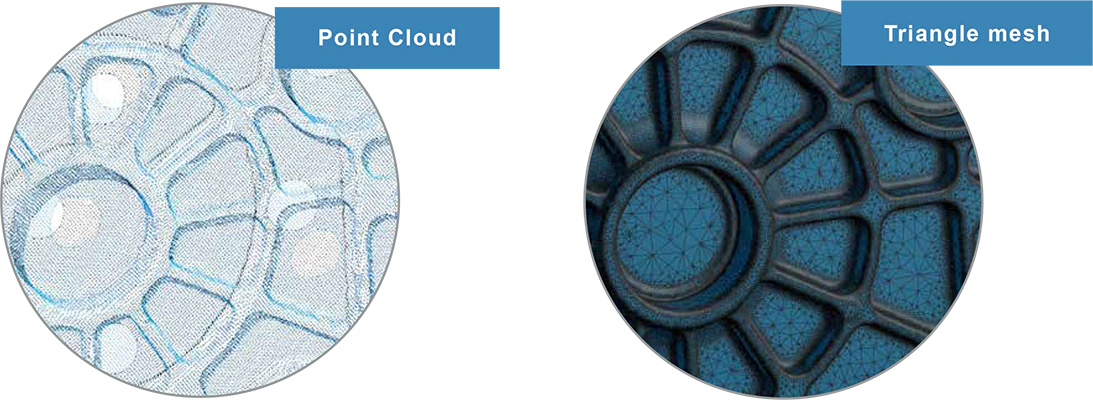
Scanning results are represented using free-form, unstructured three-dimensional data, usually in the form of a point cloud or a triangle mesh. Certain types of scanners also acquire color information for applications where this is important.
Images/scans are brought into a common reference system, where data is merged into a complete model. This process – called alignment or registration – can be performed during the scan itself or as a post-processing step.
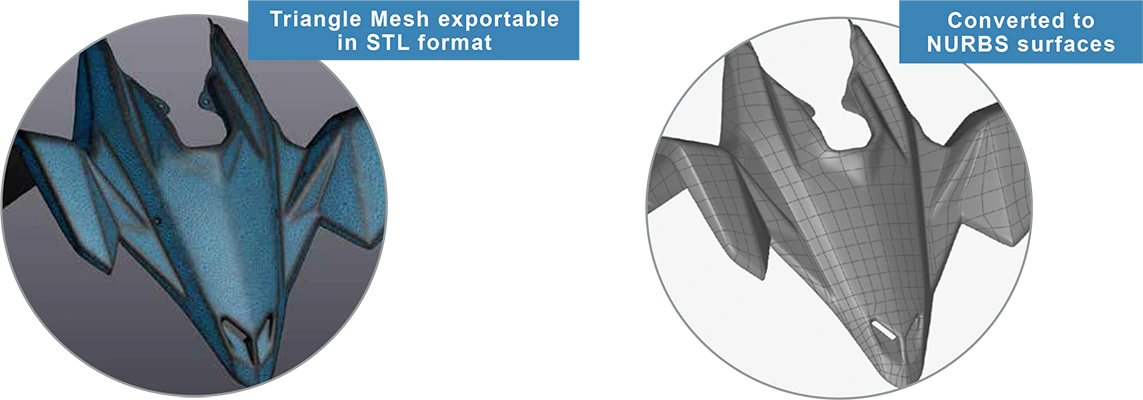
Computer software can be used to clean up the scan data, filling holes, correcting errors and improving data quality. The resulting triangle mesh is typically exported as an STL (STereoLithography or Standard Tessellation Language) file or converted to Non-Uniform Rational B-Spline (NURBS) surfaces for CAD modeling.