


Roll Texturing
Roll texturing service represent a process of changing inside structure of the metal material, or surface structure of the material of the workpiece (work roll from finishing Rolling Mill lines) by controlled electrical discharges where electrical pulses were generated between an electrode and a work roll, which results in the formation of micronic craters and recesses on its surface.
EDT machine types
Since the Roll texturing treatment of texturing rolls actually is a process in which under the effect of controlled electrical pulses between the electrodes (one, two or more rows of them) and the roll itself are forming micron craters and peaks on the roll surface, whereby the process can be carried out in a solution of a dielectric fluid depending upon the design of an EDT machine.
Nowadays in the world are widespread two types of EDT machine designes, classified by manufacturers who produce them:
1. SARCLAD / Herkules model of EDT machines: working principle is that the work roll rotates around its axis and realizes movement ahead only by the entire length of roll barrel, passing so aside to the one or two working heads for texturing within which are created micron craters and represses by the means of the corresponding electrodes (can be made of graphite, copper or so) and dielectric oil respectively there are changing the surface texture of the roll itself.
Technical characteristics of the SARCLAD EDT machine follows: operating mode pulse (+), e.g. 36 electrodes made from graphite distributed on one texturing head (for the production of up to 400 work rolls per month), the required amount of dielectric oil in the tank of the texturing heads about 2,500 liters, the range of achievable roughness Ra = 0,5–13 microns.

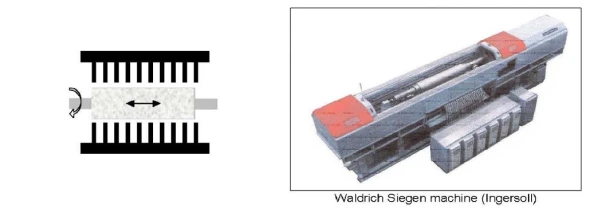
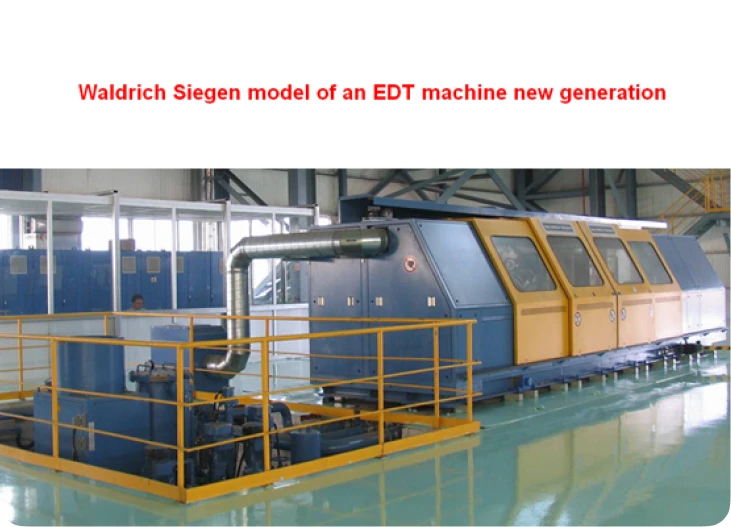
2. WALDRICH Siegen model of EDT machine: working principle is that the work roll is immersed in the tank with dielectric oil, whereby it rotates around its own axis and makes an oscillatory movement back and forth in the appropriate step, where on one side or both sides are directed copper electrodes that by means of the generator and the electrical impulses produced creates micron craters and valleys on the surface of the work roll.
Technical characteristics of the WS EDT machine follows: operating mode pulse (+ / -), eg 20 electrodes from copper arranged on one side of the work roll in the tank with a dielectric oil (for production of up to 400 work rolls per month), the required amount of dielectric fluid in the tank approximately 14.000 liters, the range of achievable roughness Ra = 1,0 – 15 microns.